No easy answers

I walk a tightrope every day. Know enough, but not too much.
It's okay to walk on this track, but not on that one. That area is out of bounds, but then someone else tells me it's not. There is a loose rumour that there is some men’s business happening so women need to stay indoors, but then again, maybe it won’t happen today or even this week after all.
Ask this, but don't ask that.
And don't ask why, because maybe it can't be explained in a way that a white person understands. Anyway, it's none of my business.
Listen and be involved, but not too much – keep to yourself. Stay away from dramas, white and black.
When I started this blog, I pledged to write about the weather and what was happening around me in the desert, and where possible and respectful what life is like in this small Aboriginal community.
As life unfolds, I can't keep that promise in the way I had hoped. I said I would write weekly. I was deluded and optimistic. The reality is that I'm using the situation as an excuse to create self-censorship, not sharing as much except 'hey, another beautiful sunset.'
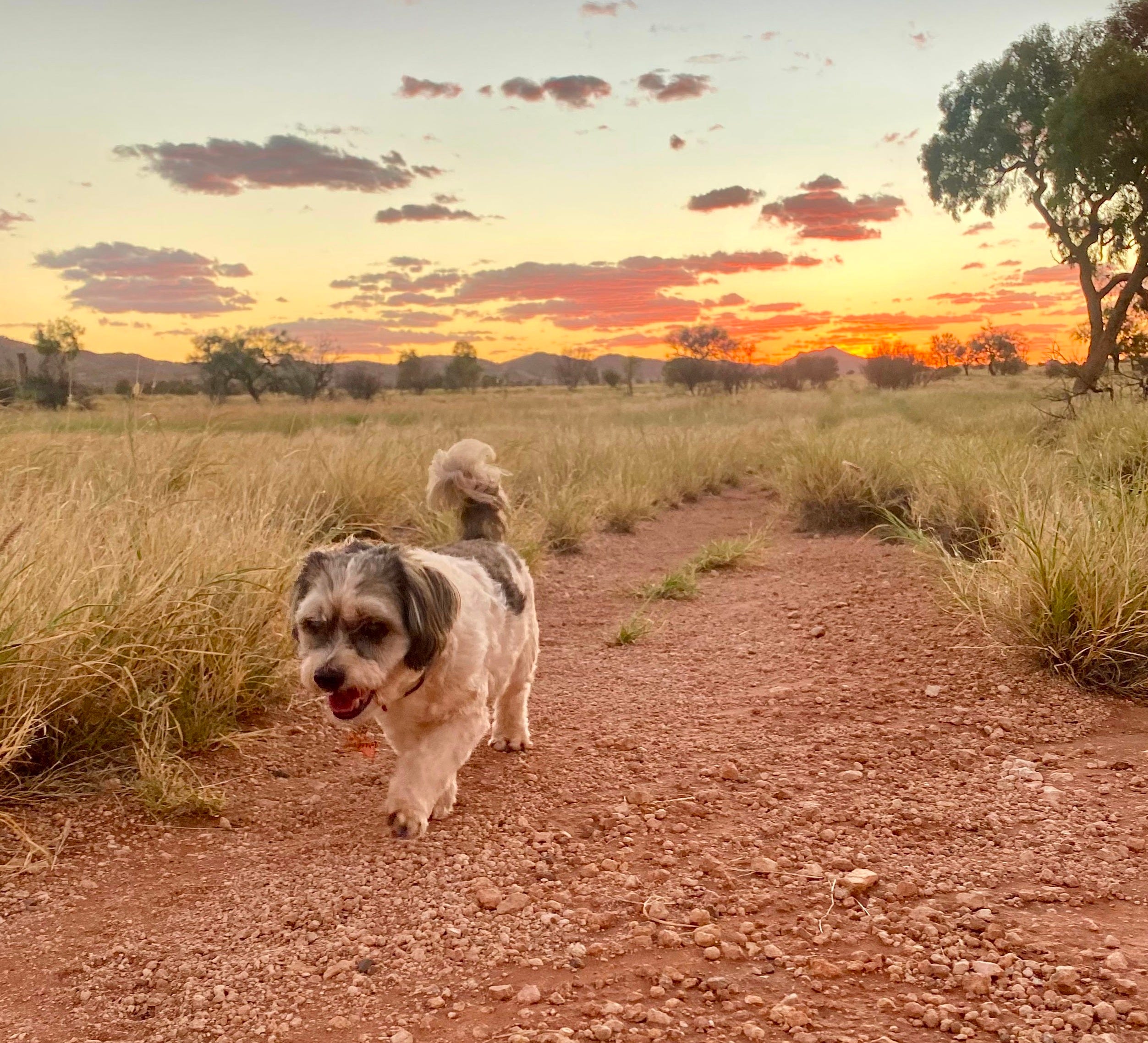
When the weather is the same, day in and day out, that doesn't make for great content.
Sharing the most fascinating things is intrusive. Asking too many questions will throw up unpalatable answers. Like, why do people throw rocks at each other and property so much? Is rock throwing a way of life? To answer this question honestly is straying into complex territory.
I had a special conversation about rocks with a seven-year-old.
Child: ‘I'm going to rock him’
Me: ‘It's not good to throw rocks, they can hurt people and damage things.’
Child: ‘What about stones?’
Me: ‘No, not stones either’
Child: ‘What about flowers?’
Me: ‘Yes, throwing flowers is okay, that's lovely’
When I get the urge to share something extraordinary, help people to appreciate how beautiful/dreadful it is, the tightrope is there. It could be a betrayal of trust, or I need to go through layers of permissions to share.
I'm a visitor here and a worker on Aboriginal land. I must respect that with everything I do, for the entire time.
I haven’t yet worked out what happens when I leave.
I've been working in the school with very young children, aged 5-7, as a classroom assistant. Actually, much of the time, we don't really know the child's age.
It’s an amazing experience.
I am bound by my employment contract with the Western Australian Department of Education, so I will only share information that is already public. It is enlightening to be around young children; they will say what they think, do as they feel, all with high-octane physicality.
Our school has a Facebook page, and the photos tell many stories, but, like any school only a portion of what actually happens.
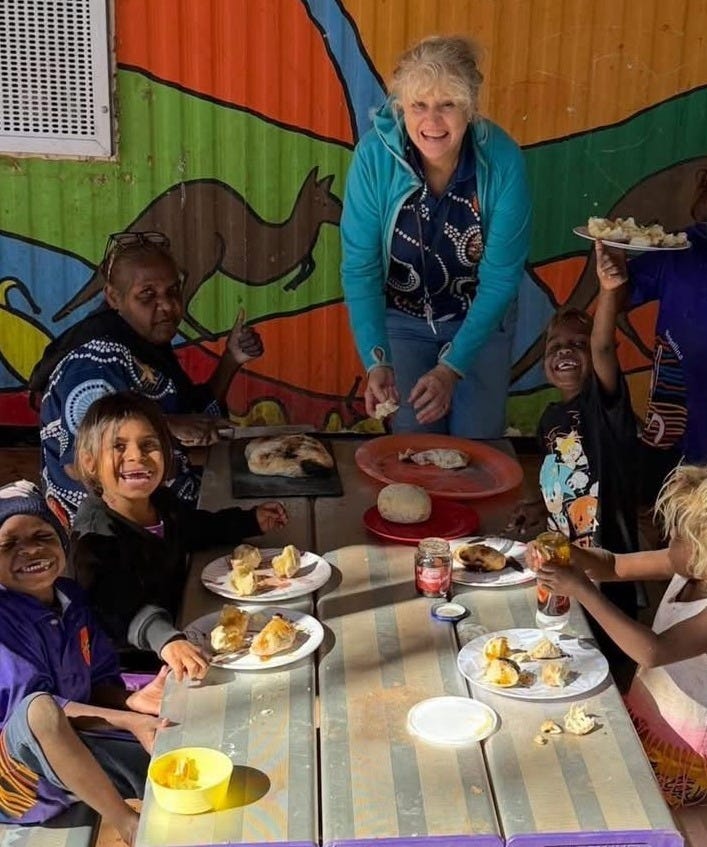
It is safe to say (and on the public record) that the kids at the school are amongst the most disadvantaged in Western Australia and probably Australia as a whole. Child wellbeing is a complex interplay of sociocultural and economic factors. Children are part of a rich strong culture. A report on child health on The Lands was released earlier this year. It’s unclear what the plans are to tackle some of the issues highlighted in this report.
Given my shift of focus towards a school environment its only natural that I dwell on other things - food, learning, reading, writing, noise, routines, dogs, cats, craft, pottering, rocks, money, dust, fire, prickles, dust, skies and light. Packet mix of life.
Put it in a bowl and stir. Bake it up, and the kids will eat it.
Chilly weather, yes
Now is the season for cool feet and hands and runny noses. Still, the skies are blue, but the wind is cold. Blankets at night are the norm.
It is dark by 4.45pm.
Clear nights with star-studded skies are the trade-off.
When you are baking in the heat, it is easy to forget that it can be damned cold in the desert, too. Temperatures have dropped to the high teens to mid-twenties. It's much easier to go about your life without the risk of heat exhaustion. At night, it is very chilly, down to about 2-7 degrees.
The locals really feel the cold. The housing for locals only has air conditioners, not split systems. Inefficient portable electric heaters are used to stay warm. White workers' homes have split systems.
Fires and blankets are the go-to sources for warmth. Firewood is collected, and arguments arise when it's stolen. There are blankets, more blankets, and hoodies. Shoes are still a rarity.
Not forgetting Summer
I've found some Bureau of Meteorology data for the nearest weather station – Giles, and for Yulara airport and Warburton, other 'major' places where they measure the temperature, for the summer months. There is no data for our community.
The monthly mean temperature for January 2025 at Giles was 41.3 degrees Celsius, Yulara's was 41.4, and Warburton's was 41.7. February is around the same.
For Giles, this was the hottest mean temperature on record. For February, it was 39.8. In 2024, it was the hottest February on record. There have been other years when it was close, but the trend is upward. In the 1970s and 1980s, the averages were in the mid-to-high thirties.
The rainfall has also been alarmingly low over the Summer and the Autumn. No significant rain since December 2024. You have to learn to love the dust.
Giles weather station is one of the most remote weather stations in the world and the most remote in Australia. Unlike many other weather stations, it is still staffed by Bureau of Meteorology people. Giles is 350 km from Uluru, and the nearest Aboriginal community is Warakurna*. The weather station has been in continuous operation since 1956 and used to run organised tours, but staffing has been reduced.
Visitors can arrive early each morning to observe the manual release of the daily weather balloon, learn about its history, and understand the significance of the weather station for national forecasting. It is located at the core of the subtropical jet stream. It is therefore key to understanding what will happen further east.
We visited the Giles Weather Station in the Summer – there is a quirky museum there and even some mosaics.
Watching the daily balloon release was a truly memorable experience. Weather monitoring stations around the world release balloons and share data, including atmospheric pressure, wind speed and direction, temperature, and humidity. It feeds into the Bureau's weather reporting, analysis and research. Around 1300 balloons are released worldwide every day, according to the World Meteorological Organisation.
Knowing that happens every day is comforting in a world with so much volatility. Weather is, afterall, predictably unpredictable.
*Midnight Oil released a song called Warakurna in 1987.
Hey Tatts , your writing holds both the beauty and the hard truths without flinching. You’ve shown so clearly the struggle to learn and connect across deep cultural gaps. Your sharp eye and gentle strength shine through — we need more of this honest seeing. Keep going, your voice matters!
I am in inner city London but reading your Substack quickly transports me to the incredible community you write about. Your ability to observe acutely, pinpoint important and difficult things others have ceased to see, and at the same time remain open with a lightness which undoubtedly keeps you going, is amazing. These are the qualities we all need to cultivate. Keep at it!